
Alex Long, the Williford Gragg Distinguished Professor of Law at the University of Tennessee Winston College of Law, was awarded the 2026 Thomas Jefferson Prize, one of the university’s top faculty honors.
The Jefferson Prize recognizes tenured or tenure-track faculty members who have demonstrated excellence in research and creative activity or made other significant achievements that may not be recognized through the university’s usual reward systems, with preference given to faculty members working in fields where external funding is limited.
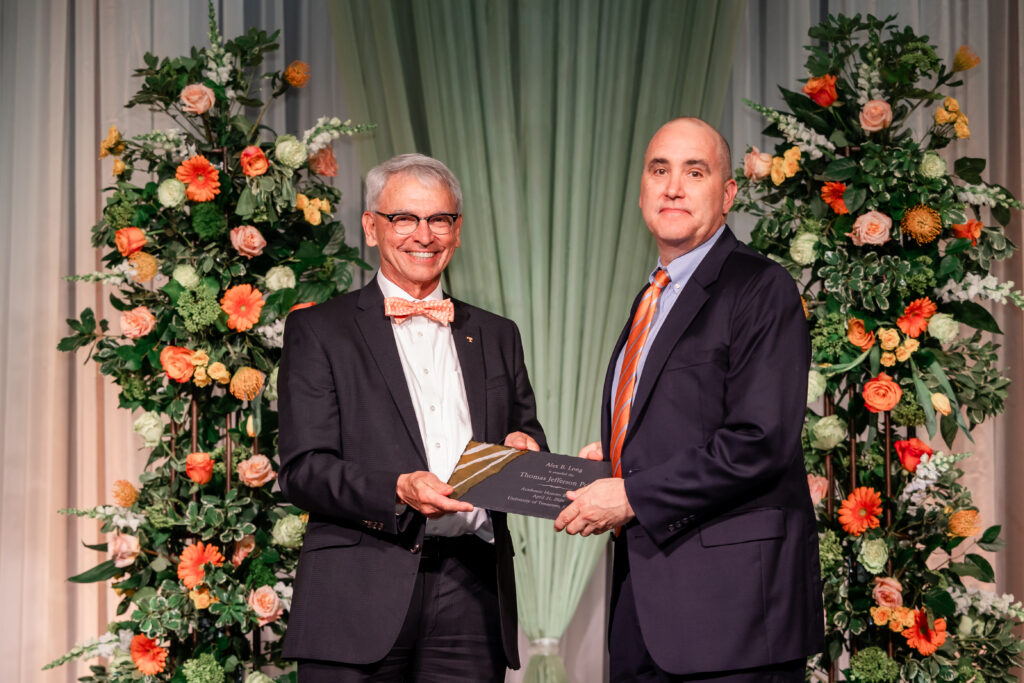
Long’s recognition continues a strong tradition of university faculty honors at Winston Law. He joins a distinguished group of college faculty members who have previously received the Jefferson Prize, including Dean Hill Rivkin (2001), professor of law emeritus; Doug Blaze (2004), dean emeritus and professor of law emeritus; Penny White (2012), professor of law emerita; and Wendy Bach (2023), professor of law and co-director of the Appalachian Justice Research Center. The college’s impressive string of recipients for this high honor is a testament to Winston Law’s longstanding scholarly influence in the legal field.
“For me, the particular honor is that it is a university-wide award,” Long says. “There are a whole lot of great scholars at UT, and just to be recognized among them is highly rewarding.”
While at Winston Law, Long has published widely on a topics such as disability and employment law, torts, and legal ethics and professionalism. “I’ve sort of written about whatever I find interesting,” he says. “That’s meant that I’ve written about a lot of different things. I took a little detour and wrote about judges’ use of music lyrics in judicial decisions, and that ended up with a couple of different articles and with me doing an interview with NPR’s All Things Considered.”
Long’s most recent scholarship focuses on the world of sports and civil rights. He is currently working on a book (to be published by the University of Virginia Press) concerning athlete boycotts over civil rights during the 1960s. His most recent law review article, to be published in 2027, focuses on the application of the Americans with Disabilities Act to the world of sports. In 2024, he published Professional Wrestling and the Law, a book that explored lawsuits and legal theories implicating the world of professional wrestling.
Even in researching topics that interest him, Long aims to produce scholarship that influences legal practice. He considers it a particular honor that multiple judges have cited his work their decisions.
“I’ve had some of my scholarship cited by courts in disability discrimination cases, employment discrimination cases, torts cases, and that’s all been highly rewarding,” Long says. “I always want my scholarship to be practical, and a lot of it, I think, is geared toward judges and helping to influence how they approach legal issues.”
Long has been recognized multiple times for his scholarship, service, and teaching. Winston Law has honored him with the Carden Award in each of those areas and in 2011 named him as the college’s Harold C. Warner Outstanding Teacher.
Since joining the faculty in 2007, he has come to appreciate Winston Law’s emphasis on training students to be practice-ready and fostering a supportive community on campus.
“There’s not the level of cutthroat behavior that you sometimes see in law schools,” he says. “Our students support each other and there’s a good relationship between students, faculty, and staff that, I think, sets us apart from a lot of other law schools.”